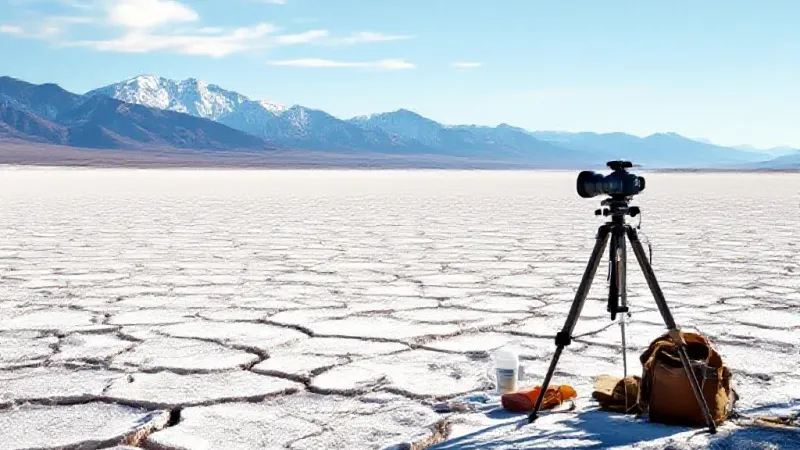
As the Great Salt Lake drops toward a historic low, questions persist about dust rising from its dry bed and its potential effects on human health. At a Monday forum focused on solutions for the dust issue, researchers and a state official provided updates on ongoing efforts to understand the problem.
At the University of Utah, dust scientists are working to determine how much dust is blowing in from the lake compared to other sources, such as mining. Derek Mallia, a research assistant professor at the university, stated that he and his colleagues are developing models to account for urban emissions and pinpoint specific areas of the lake bed that are generating the most dust. Mallia told Utah News Dispatch that findings from their current project are expected to be shared early next year.
Key questions remain regarding the exact composition of the airborne dust, including concentrations of heavy metals like arsenic and lead, and whether these pose health risks to the 2.5 million people living along the Wasatch Front. Clear timelines for answering these health-related questions are not yet established.
Bryce Bird, director of the Utah Division of Air Quality, addressed concerns about arsenic, a known carcinogen, noting, “we know it’s in the sediment.” However, initial data collected by the division from filters on high-wind days showed airborne arsenic to be "basically below the detection level that our laboratory could detect."
Bird indicated at the Monday forum, hosted by the Great Salt Lake Alliance, that the division has "other air pollution concerns that I think are more pressing to us, public health-wise, than the Great Salt Lake today." He characterized the Great Salt Lake dust as "a future issue." Bird pointed out that so far this year, the Salt Lake Valley has not exceeded federal standards for coarse PM10 pollution, which is measured over a 24-hour period. In contrast, he noted that the ozone standard has been exceeded 19 times this year, making ground-level ozone in urban areas a more pressing concern for regulators regarding current public health impacts.
The division is working to establish more dust monitors across northern Utah, following an initial slow start that reportedly frustrated academic researchers who advocated for more comprehensive monitoring. Bird shared that the division plans to release data collected by these new devices on a rolling basis. However, he cautioned that interpreting this information will be challenging until the state develops guidelines for how much of these metals are safe to breathe over short periods.
While federal standards exist for concentrations in soil, water, and for workers exposed to dust from materials like marble and concrete, there are no specific federal standards for dust storms. Consequently, Utah is developing its own guidelines. This process involves convening environmental and public health officials to review relevant research and coordinate with the U.S. Environmental Protection Agency. Bird did not provide an estimate on Monday for when these state guidelines would be finalized.
David Parrott, assistant director of Westminster University’s Great Salt Lake Institute, is collaborating with researchers studying microbes and heavy metals, examining their effects on lung cells grown in culture. Parrott expressed encouragement over the breadth of research dedicated to the lake, also acknowledging the efforts of many others in the state, including lawmakers, who are working on solutions to preserve the lake ahead of the 2034 Winter Olympics in Salt Lake City.
Despite the upcoming Olympics being eight years away, Parrott stressed the urgency of continued action. He advised against losing momentum and delaying efforts, stating, “We need to do it now.” Bird also highlighted the severe consequences when lakes dry up globally, often making areas unlivable, and underscored that residents of Utah "don't have that option here" and "need to find ways to address it."