U.S. Sen. John Curtis announced Monday he is actively working to garner political support in Congress for President Donald Trump’s proposed $1 billion federal investment in the Great Salt Lake. Speaking at the University of Utah’s Hinkley Institute of Politics in Salt Lake City, during an event hosted by the Sutherland Institute, Curtis underscored the necessity of Congressional approval for the president's budget request.
“Now we, as legislators, have to figure out where that money’s going to come from,” the Utah Republican stated, highlighting the challenge of convincing colleagues of the investment’s worth. Curtis said he is inviting fellow legislators to Utah, engaging in discussions, and educating them on the issue.
Utah leaders also play a crucial role, according to Curtis, by demonstrating how a billion-dollar investment would be utilized to save the lake. While Curtis expressed hope for the funding in this year’s budget, he warned that securing the full $1 billion may take multiple years. He also projected that federal investment could ultimately surpass $1 billion, and he believes it should.
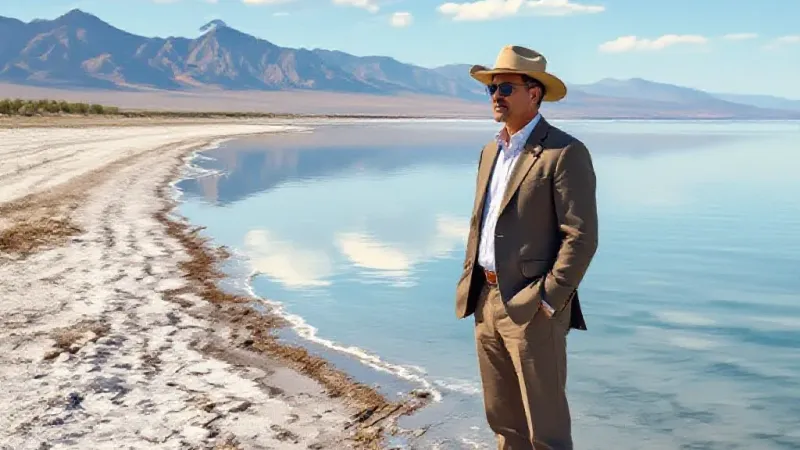
Curtis framed the shrinking Great Salt Lake as a critical “regional issue,” posing ecological and economic threats not only to Utah but to the entire Western United States. He also suggested that successfully saving the saline lake, an accomplishment unprecedented globally, could have significant international implications.
His comments came during a livestreamed interview with Sen. Todd Weiler, a Republican legislator who also serves as president and CEO of the Sutherland Institute. Weiler mentioned various ambitious ideas that have been proposed to address the lake’s plight.
Curtis himself has called for "pioneer-scale ambition" to address the challenge. In August, he convened a panel of experts and policymakers to brainstorm “bold and audacious” solutions for the Great Salt Lake, KSL reported. Among the ideas discussed, Curtis pointed to proposals such as piping water from Idaho or Louisiana, or a partnership with California to fund desalination efforts there, which would reduce California’s draw from the Colorado River.
Regarding these dramatic interventions, Curtis asserted that if such actions were taken today, 50 years from now they would be considered “cheap.” Weiler expressed confidence that the desalination partnership with California “actually has merit” and will “probably happen.”
Curtis emphasized that the ongoing conversation about saving the Great Salt Lake needs to move beyond water conservation alone. He said, “We have to change the math. There is not enough water, even with conservation.” He advocated for more audacious thinking, suggesting solutions that might currently seem impossible.
When asked about mandates as a solution, Curtis expressed skepticism about their efficacy in many situations, citing examples like shower times or lawn sizes. However, he agreed with Weiler’s suggestion that requiring water metering statewide would be an effective measure. “I like that one,” Curtis stated.
The discussion also touched on the perception of farmers as “boogeymen” in the water crisis. Weiler noted that alfalfa, often criticized for its water usage, is frequently grown outside the Great Salt Lake watershed, implying that banning it might not have the expected impact. Curtis warned against scapegoating, stating that focusing on blame creates enemies rather than solutions. He urged collaboration, saying, “We need everybody on the team,” and called for unified efforts to find solutions, emphasizing that "nobody’s at fault here. It is what it is.”
Addressing concerns from young Utahns about future water reliability, Curtis encouraged them to “roll up the sleeves and be part of the solution,” rather than considering leaving the state.