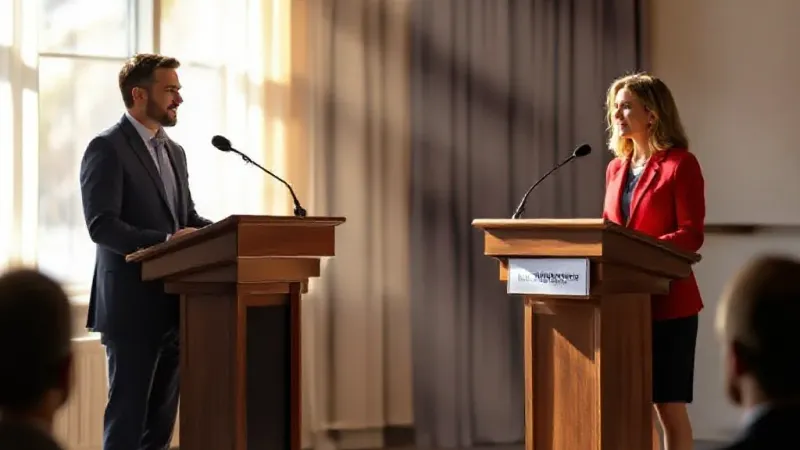
Republican incumbent Rep. Blake Moore and Democratic challenger Peter Crosby debated at Utah State University (USU) on Tuesday, three weeks before the November 3 election. The candidates for Utah’s newly-drawn 2nd Congressional District addressed a range of issues, including water, energy, the shrinking Great Salt Lake, and the national debt, offering voters contrasting views on representing northern Utah's interests. The debate, hosted by the Utah Debate Commission and broadcast live by PBS Utah, covered policies relevant to residents, commuters, and business owners across the district.
Rep. Moore, defending his record, presented himself as a productive member of Congress focused on solutions rather than what he called "toxic" politics. Moore highlighted legislative work, stating he has passed more legislation than others in his cohort, affecting areas from the Great Salt Lake to Hill Air Force Base, and promoting pro-growth and family tax policies. He affirmed his commitment to continuing these efforts.
Peter Crosby, an adjunct professor for the Center for Anticipatory Intelligence at USU, argued he is the appropriate candidate to fix what he described as a "broken system" and to build a future for generations to come. Crosby emphasized a key difference with Moore, stating that Moore is content with the current path, while he himself is not. He contended that different representation is needed for different outcomes.
Despite their areas of disagreement, Moore and Crosby shared common ground on several topics. Both candidates expressed support for local control over the development of data centers. They also both called for the creation of a fiscal commission to address the national debt and credited Utah state leaders for their approach to artificial intelligence regulation.
The debate, moderated by KUTV news anchor Heidi Hatch, remained policy-focused without heated exchanges, but Crosby did criticize Moore on specific issues. Regarding tariffs, Crosby argued that Moore has supported policies, particularly under the Trump administration, that have harmed Utahns and disproportionately impacted the agricultural community. Crosby asserted that a broad tariff regime acts as an effective tax on American citizens. He also linked rising fuel prices to the Iran War, stating that executive decisions affecting oil producers and transportation have negatively impacted the agricultural sector.
In response, Moore acknowledged he did not expect fuel prices to rise as they have under Republican leadership, and called the war in Iran a major problem. He stated he has encouraged a ceasefire and expressed hope for a memorandum of understanding to resolve the conflict. On gas prices, Moore mentioned a permitting bill expected to pass in coming months, aimed at increasing domestic supply to reduce reliance on foreign sources, which he believes could offer substantive relief.
Crosby countered Moore's remarks on fuel prices and the Iran war, stating that solutions require votes, not just hope. He suggested that only a few Republican votes in the House could end the war in Iran, arguing it simply requires courage for representatives to prioritize district needs over party loyalty.
Crosby also attacked Moore on energy development, accusing Congress and the previous Trump administration of stripping subsidies for residential solar through a budget and tax bill. He claimed this action deliberately and directly targeted the northern Utah solar industry, potentially leading to a loss of up to $1.8 billion in economic revenue and destroying Utah jobs. Crosby noted that Moore had co-authored the bill.
Moore pushed back on Crosby's claims about energy policy. He stated that a bipartisan group in Congress is working on energy permitting reform with an "all-of-the-above energy approach." Moore also asserted he advocated for solar companies, and that solar companies across Utah would confirm his efforts to engage in tough conversations and strongly push back in their support to ensure a level playing field.
Recent polling suggests a tighter contest for Moore in the 2nd Congressional District, which was redrawn by a court order. A poll commissioned by the Utah Debate Commission, conducted between September 10-24 and surveying 515 registered voters, showed Moore with 39% support and Crosby with 34%. Other candidates, Daniel Cottam (Libertarian), Carlton Bowen (Independent American), and Robert Moesinger (unaffiliated), who did not qualify for the debate, received 4.9%, 4.1%, and 4.9% respectively. Approximately 10.7% of voters were undecided, and the poll had a margin of error of plus or minus 4.32%.
The Utah Democratic Party stated these poll results indicated Crosby was within striking distance of Moore. Moore, when asked about the poll, expressed confidence in his campaign but acknowledged that third-party candidates and undecided voters could introduce variables into the outcome.
Crosby’s message to undecided voters is that they have a choice between change, offered by him, or the status quo, represented by Moore. Crosby framed his discussions with voters around understanding their needs and finding solutions.
Ballots were mailed to eligible registered voters across Utah on the same day as the debate. Voters can cast their votes immediately by mail, using drop boxes, or at early polling places. For those waiting until Election Day, November 3, polls will close at 8 p.m.