
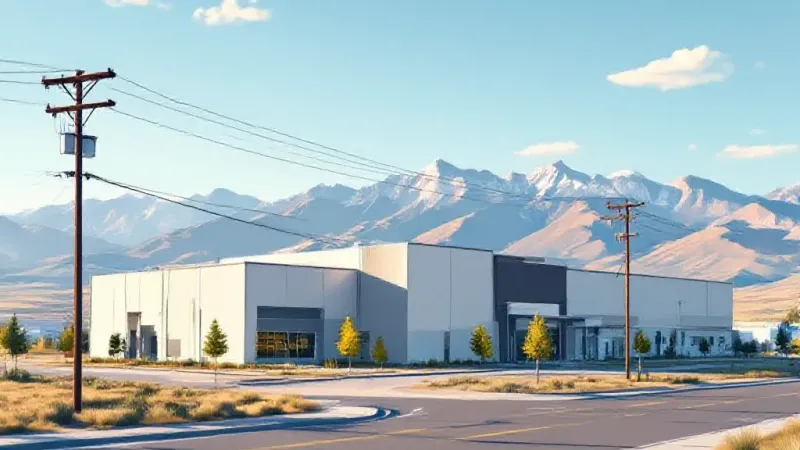
Utah is seeing a significant shift in its data center landscape, as new, large-scale facilities designed for artificial intelligence (AI) draw increased public scrutiny. This comes after decades of smaller data centers quietly serving as the physical backbone of the internet, according to industry observers.
Utah currently hosts at least 48 operational data centers, as noted by Shon Hiatt, a University of Southern California professor who has studied the state's data center landscape and authored a recent report for the Kem C. Gardner Policy Institute. However, the report highlights that seven additional data centers currently under construction are projected to consume more energy than all 48 existing facilities combined.
This construction boom has sparked bipartisan opposition nationwide, with a significant majority of Utahns expressing reservations. A Utah State University survey released recently indicated that nearly 76% of respondents oppose or strongly oppose building new data centers in the state. The survey also found that 90% consider the amount of water a project consumes to be "very important" when deciding whether to support or oppose it.
Hiatt suggests that some of this opposition reflects broader societal anxieties about the future of artificial intelligence itself. He observed that questions about AI's impact on society and jobs contribute to a "negative sentiment towards AI," which is now shifting to the data centers that support it.
Industry leaders emphasize that not all data centers are alike. Pete Ashdown, president and founder of XMission, which has operated a small data center in downtown Salt Lake City for over 25 years, points to "two different stories" in the industry. He distinguishes between traditional data centers, which handle services like email and webpages, and a newer style of hyperscale data centers.
Bob West, vice president of marketing for ValorC3, which operates a smaller data center in St. George, explains that the emergence of technologies like ChatGPT in 2022 and 2023 was a "game changer," initiating an "AI race." This rapid demand for computing power caught the data center industry off guard, leading to a frenzy of construction.
Chris Damrow, director of facilities management at ValorC3, describes their colocation center as "a hotel for companies’ or individuals’ very expensive computers," providing power and cooling for clients ranging from healthcare to financial institutions. ValorC3’s St. George facility has a capacity of about 4 megawatts and uses a direct expansion system with refrigerant for cooling, rather than water. Damrow noted that this system can be more energy-intensive, but ValorC3 actively manages energy use to avoid financial losses.
XMission's Salt Lake City facility operates with an even smaller footprint, at just under 1 megawatt. Ashdown explains that it uses a closed-loop cooling system, similar to a car radiator, that does not continually consume new water. He argues that hyperscale data centers, designed to pack equipment densely with significant power and water use, have far more "intense" environmental impacts due to their sheer scale.
These hyperscale data centers are predominantly owned and operated by major technology companies and require "a very, very big footprint and a lot of power," according to Damrow. To illustrate the difference in scale, ValorC3’s 4-megawatt capacity is several thousand times smaller than the Stratos data center planned for Box Elder County, which has garnered considerable attention.
West believes the industry could improve transparency and communication regarding the critical role data centers play in the increasingly digital economy. He also anticipates that the industry will find more efficient ways to manage resources over time, stating, "The data center industry is really good at evolving, and technology is great at evolving."
However, Ashdown remains skeptical of the need for such large-scale facilities, suggesting that the demand may be speculative. He predicts that as computing becomes more efficient, the need for vast campuses will diminish, quipping that these AI data centers "are probably going to be pickleball courts in 10 years." Ashdown also expressed skepticism about promises from technology companies regarding their ability to mitigate negative environmental impacts.
Nationally, over 1,500 data centers are under construction, according to April data from the Pew Research Center, with most planned for the South and Midwest. The West shows a 34% increase with 277 planned facilities. Hiatt notes that Utah, while growing, is experiencing a "sustained, manageable growth" compared to some other states, placing it in the middle of the pack nationally both in operational and under-construction data centers. Despite the concerns, West affirmed an "overwhelming amount of demand" that many providers are currently unable to meet.