
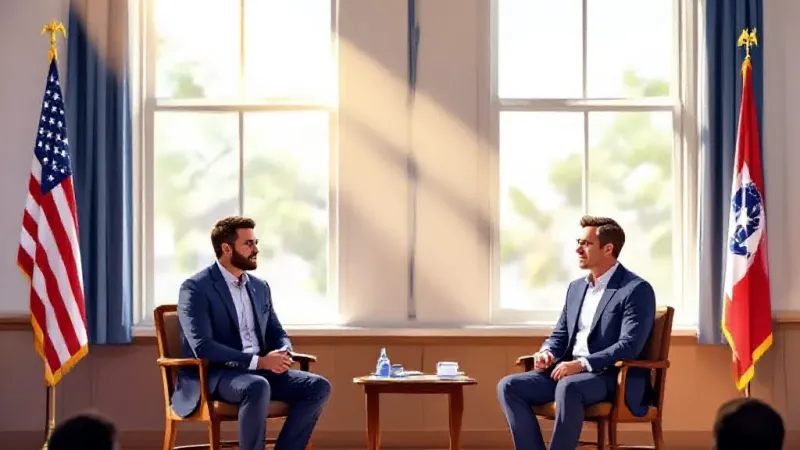
Candidates vying for Utah’s 1st Congressional District, Democrat Ben McAdams and Republican Riley Owen, largely found areas of agreement during a debate held Tuesday. Their exchange, described as a shift from more divided national political campaigns, saw both candidates, perceived as moderates by members of their respective parties, align on several key issues.
The debate, hosted by the Utah Debate Commission and broadcast by PBS Utah, was moderated by Natalie Gochnour, director of the Kem C. Gardner Policy Institute at Salt Lake Community College. Jesse West, a Libertarian, and Elias Montgomery, an unaffiliated candidate, also sought the seat but did not meet the commission's minimum 10% support threshold to participate.
Central to their discussion was the issue of gerrymandering, specifically regarding the lawsuit that led to the creation of the new blue-leaning district they are competing to represent. McAdams attributed congressional corruption and the inability to solve problems to gerrymandering, stating it pushes politicians to cater to extremes, making bipartisan work difficult. He specifically thanked Better Boundaries, the group behind the anti-gerrymandering lawsuit that led to the new state congressional maps.
Owen, while not thanking Better Boundaries, expressed frustration with the new maps. He noted that the resulting boundaries created three of the most Republican-leaning districts in the country and one of the most Democratic-leaning districts. Owen contended that this configuration creates a "breeding ground for extremism," a sentiment that largely mirrored McAdams’ concern about a polarized political climate.
Beyond district mapping, the candidates found common ground on other significant policy matters. Both McAdams and Owen agreed on the necessity of federal regulations for artificial intelligence. They also shared a commitment to implementing higher standards for the conservation of the ailing Great Salt Lake, particularly in light of the surge in data centers near the lake.
However, a clear division emerged during an unmoderated exchange on new work requirements for recipients of Medicaid and the Supplemental Nutrition Assistance Program (SNAP). McAdams criticized such policies, stating, “What we’ve done with Medicaid is we’ve created a maze, and then we play ‘gotcha’ for people who get lost in the maze through complicated paperwork.” He also pointed out that the current administration had cut Utah’s targeted adult Medicaid program, which he described as a lifeline for many individuals seeking stability and reintegration into society.
Owen countered, recalling that work requirements were a hallmark of welfare programs under the Bill Clinton administration, which he said Democrats had supported. He argued that such requirements were not unreasonable, questioning McAdams’ stance by asking, “Ben, can I just ask what happened to the party of Bill Clinton?”
The debate also offered insights into each candidate's political approach. Owen, a naval officer and former White House staffer, often diverged from the agenda of the previous Trump administration. He told reporters after the debate that he believes there are things President Trump got both right and wrong, a view he applies to every president and both parties. Owen also emphasized that a key distinction between him and McAdams is his preference for market-based incentives over what he perceives as a desire for “bigger government” from his opponent.
McAdams, who was the last Democrat from Utah to serve in Congress, noted his own history of splitting from his caucus. However, he expressed skepticism about Republican candidates doing the same, citing a past experience where he was the only member of the Utah delegation to vote for the Dream Act, despite broader verbal support.