
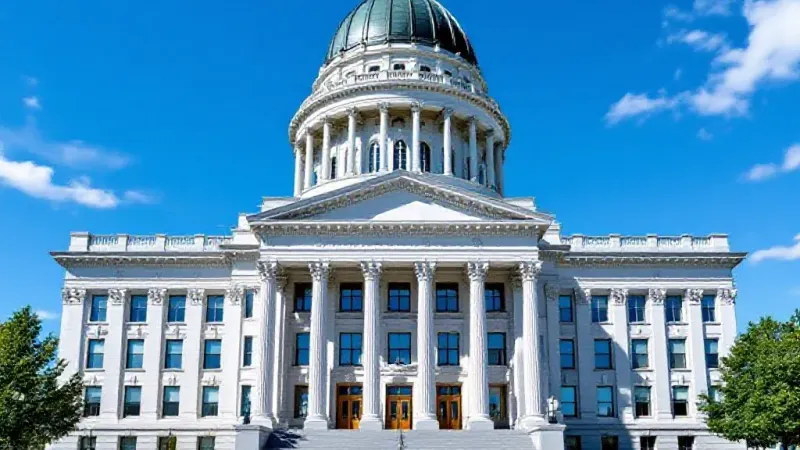
SALT LAKE CITY — The Utah Senate confirmed two more new justices to the Utah Supreme Court on Wednesday, capping an era of major changes to the state’s highest court. This impacts how laws and the state constitution will be interpreted across Northern Utah and the entire state.
On Wednesday, the Senate voted 26-2 to consent to the appointments of 5th District Judge Matthew Bell and civil litigator Michael Menssen. The two men will fill vacancies created by the retirement of longtime Chief Justice Matthew Durrant and the resignation of former Justice Diana Hagen.
While the appointments of Bell and Menssen faced no floor debate and little controversy, two Democratic senators, Nate Blouin and Kathleen Riebe, voted against both nominees. Sen. Riebe stated her no vote was due to the “lack of diversity” and “lack of women” within the Legislature and the state’s highest court. She noted that until recently, the court had a majority of women, but with Hagen’s resignation and a two-seat expansion, Associate Chief Justice Jill Pohlman and Justice Paige Petersen are now outnumbered by five men. Riebe questioned if a scarcity of female applicants stemmed from women not feeling comfortable.
These confirmations followed a unanimous recommendation on Monday from the Senate Judicial Confirmation Committee, which includes two Democrats, to advance both Bell and Menssen’s appointments to the full Senate.
Their appointments complete a near-total overhaul of the Utah Supreme Court. This extensive change stems partly from the Republican-controlled Utah Legislature’s decision earlier this year to expand the court from five to seven seats. Additionally, there has been high turnover due to Justice Durrant’s retirement in August, former Justice John Pearce’s retirement last year, and Justice Hagen’s resignation in May.
With these latest confirmations, Gov. Cox has appointed six out of the seven justices currently sitting on the state’s highest court, with all the newest positions filled within the last year. Last fall, Gov. Cox appointed John Nielsen to replace Justice Pearce. Earlier this summer, Cox selected attorneys Jay Jorgensen and Stephen Dent to fill the two new seats created by the court's expansion. Justice Petersen was appointed by former Gov. Gary Herbert in 2017.
Judge Bell, who has served nine years as a 5th District Court judge in southern Utah, including Washington, Iron, and Beaver counties, was previously an assistant U.S. attorney and a trial attorney in the U.S. Department of Justice’s antitrust division. He began his career as a corrections officer and police officer and is a graduate of Brigham Young University.
Michael Menssen is an attorney specializing in complex commercial and labor law. When announcing Menssen’s appointment, Gov. Cox described him as “one of the finest civil litigators in our state” and commended his work to expand legal aid for low-income Utahns. Menssen received his law degree from the University of Virginia.
During their confirmation hearings, both Bell and Menssen emphasized their focus on “originalism” and “textualism,” judicial philosophies that interpret the Constitution based on its original meaning. These philosophies have been highlighted by Gov. Cox and Republican legislators as important for future Utah Supreme Court justices to uphold.
Lawmakers questioned the nominees on topics related to the Utah Supreme Court’s role in “checking” other branches of government and how they would approach previous rulings they might disagree with. These questions arose amid recent legislative and judicial tensions, particularly concerning an anti-gerrymandering lawsuit. That lawsuit, brought by the League of Women Voters of Utah and Mormon Women for Ethical Government, thus far struck down the Legislature’s 2022 congressional boundaries as unlawful. The courts replaced those boundaries with a court-ordered map being used in this year’s elections after 3rd District Judge Dianna Gibson ruled the 2022 boundaries resulted from an unconstitutional process. That process involved lawmakers repealing and replacing a voter-approved 2018 law known as Better Boundaries’ Proposition 4, which had established an independent redistricting commission and neutral map-drawing standards.
In the wake of these rulings, and amid ongoing outcry over the anti-gerrymandering case, the Utah Legislature expanded the Utah Supreme Court and passed a law giving the governor and the Senate say over who the high court’s next chief justice will be.
Sen. Todd Weiler, R-Woods Cross, asked the nominees about the authority of a Utah judge to declare elected branches in violation of the Utah Constitution and the limits on a judge’s own authority. Bell responded that the Utah Constitution “forbids judges from … the exercise of executive or legislative power.” He clarified that he does not view himself as a “check” on the other branches but as an independent branch, with the Constitution serving as the check on all three.
Bell further stated that while he has a constitutional duty to invalidate legislative or executive actions that exceed their boundaries, it is paramount to “vigorously police the boundaries of my own authority.” Menssen pledged that being “entrusted to interpret the Constitution and the laws of the state of Utah is a sacred responsibility” and that he would always give the position the necessary work and respect.
Both Bell and Menssen were joined by their families in the Senate chamber during the votes, with Bell holding his wife’s hand and Menssen acknowledging the senators’ applause.