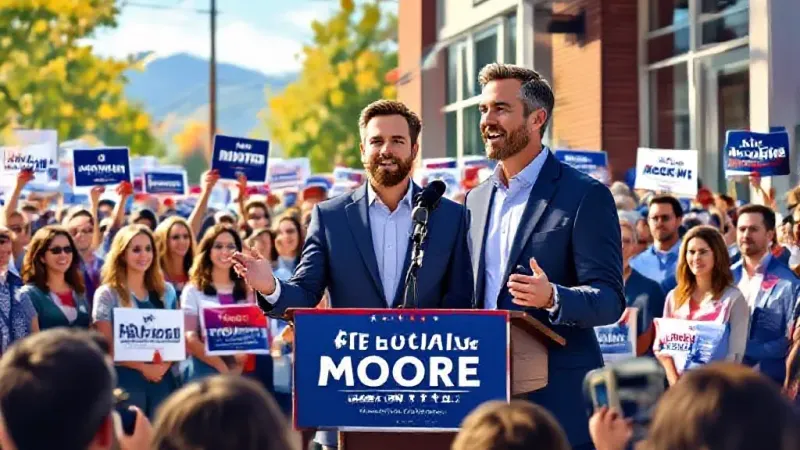
Utah’s three right-leaning congressional incumbents took early leads after polls closed Tuesday night, with Republican Rep. Celeste Maloy becoming the first and only declared winner in those races by The Associated Press later that evening. As Utah News Dispatch reported, all three incumbents—Blake Moore, Mike Kennedy, and Maloy—campaigned in newly redrawn U.S. House districts following a yearslong legal battle over Utah's redistricting maps. If their leads hold, the conservative representatives will return to a Congress controlled by Democrats and will join a state delegation that now includes newly elected Democratic Rep. Ben McAdams.
Under the court-ordered map redraw, a safe Democratic district was carved out in Salt Lake County, where McAdams secured victory with 72 percent of the vote as of Tuesday night. The redraw required Moore, Kennedy, and Maloy to run for different seats than those they currently hold, introducing each candidate to new voter bases across the state.
In Northern Utah’s 2nd Congressional District, which emerged as the closest of the three races on election night, incumbent Blake Moore led Democratic challenger Peter Crosby 50 percent to 43 percent. Central to the debates in the 2nd District were regional concerns over the proposed Stratos data center and the ecological decline of the Great Salt Lake.
Prior to the election, the Utah Democratic Party highlighted polling from September commissioned by the Utah Debate Commission, asserting that Crosby was within striking distance of the incumbent by trailing by just five percentage points. Addressing reporters during a virtual news conference, Moore observed that his election night lead aligned closely with recent polling trends. He noted that national economic conditions, including high gas prices during a period when Republicans held the White House, House, and Senate, typically lead to political pushback against the party in power. Looking ahead, Moore expressed confidence that the state's federal representatives would maintain a collaborative approach to Utah's priorities, pointing specifically to nonpartisan matters such as the 2034 Winter Olympics and the ongoing efforts to restore the Great Salt Lake.
Meanwhile, in the sprawling 3rd Congressional District—which encompasses more than half of the state and touches three of its borders—Celeste Maloy established a comfortable lead over Democratic nominee Kent Udell, securing 58 percent to Udell’s 35 percent. Speaking to supporters in St. George, Maloy noted the dramatic shift in her constituency, explaining that she was moving from representing 13 western counties to retaining only six of them, requiring her to introduce herself to approximately 700,000 new residents.
Maloy, an attorney, former congressional staffer, and current chair of the Congressional Western Caucus, framed her campaign around her record as a problem-solver. Policy differences were stark in the 3rd District contest: Maloy previously backed executive orders that reduced the size of the Grand Staircase-Escalante and Bears Ears national monuments, whereas Udell publicly condemned those reductions and advocated for further examination of nuclear energy development.
In the 4th Congressional District, freshman Rep. Mike Kennedy built a 52 percent to 41 percent lead over Democratic challenger Jonny Larsen. Speaking to supporters in Draper as ballots were still being tallied late Tuesday, Kennedy emphasized his commitment to serving his constituents regardless of national party shifts. Kennedy campaigned on his efforts to reduce federal scope, while Larsen ran as a moderate Democrat focused on fiscal responsibility and national security matters.
All three Republican incumbents received late endorsement boosts on social media on Monday from President Donald Trump. However, Trump notably did not issue an endorsement in the new 1st District race, where moderate Republican and former Trump White House staffer Riley Owen ran against McAdams.
During the state Republican party gathering in Draper, Utah Republican Party Chair Rob Axson addressed supporters alongside local lawmakers and conservative activists, expressing optimism about local turnout despite emerging national Democratic victories in key U.S. Senate contests.