
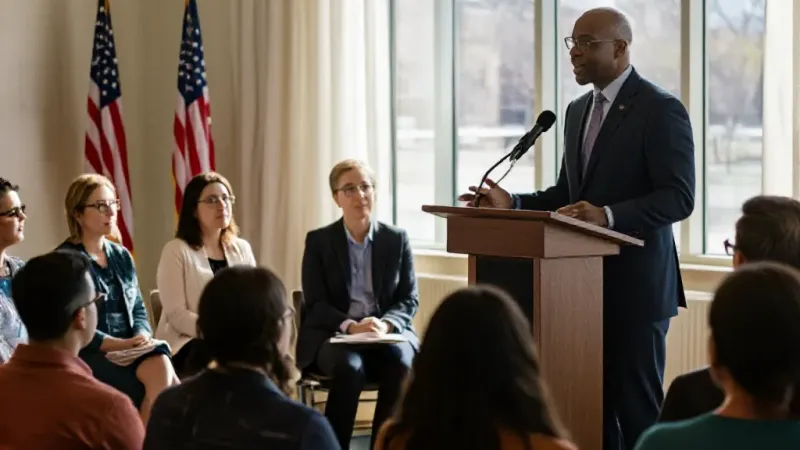
The News Literacy Project convened its first national conference last week in Salt Lake City, bringing together educators and journalists to emphasize the critical need for K-12 students to develop strong news literacy skills. Pierre Thomas, chief justice correspondent for ABC News, highlighted the project's mission, which he champions, as vital for an informed public.
Thomas, based in Washington, D.C., shared that his own journey to becoming an educated and informed individual, and eventually a journalist, began with a nightly family ritual of watching "World News Tonight with Peter Jennings." He conveyed these convictions at the Salt Lake City conference, where he moderated a panel exploring how to equip young people to navigate the vast amount of information they encounter daily.
The News Literacy Project is a nonpartisan education nonprofit that collaborates with K-12 educators. Its programs teach students how to think critically about information, identify misinformation and bias, and discern the differences between news, advertisement, opinion, and entertainment content. Thomas emphasized that this work does not promote any specific media outlet or political viewpoint but rather empowers young people to find reliable information and make their own decisions. Thomas added that teaching students to understand the news and how to gather information is more critical than ever, stating that 'a public that is not informed cannot make good decisions about anything.' He noted that providing people with tools to navigate and understand complex information serves as a counter to negativity and tribalism.
Utah schools have been early partners with the News Literacy Project. Gretchen Zaitzeff, district library media specialist for Canyons School District in Sandy, spoke on the panel moderated by Thomas. Zaitzeff is actively working with 300 educators in her district to integrate information, news, and media literacy into their K-12 curricula. She views news literacy as an essential skill that complements academic subjects and prepares students for active civic participation.
Zaitzeff articulated the profound importance of this education: 'if we can’t help them find accurate information in those fields, what does it matter that they have this foundation?' She stressed that without these skills, students may struggle to discern trustworthy information in the wider world.
The panel also included John Arthur, a Democratic state legislator and Utah’s 2021 Teacher of the Year, and Patricia M. Hunt, a social studies educator with 33 years of experience from Wakefield High School in Arlington, Virginia, along with a representative for local journalism. The discussion reinforced the idea that strong news literacy relies on access to quality news sources.
A local journalism representative from Weber County reflected on their childhood, recalling how daily interaction with the Standard-Examiner and columnists like Mark Saal fostered an early understanding of community events and the role of local journalists. This individual raised the question of how today's youth, like their own daughter, will develop similar community interest and find reliable information in a different media landscape.
For journalists like Thomas, accuracy and fairness are paramount in every story. Similarly, reporters at Utah News Dispatch strive to clearly present the impacts of policy decisions. The article concluded by urging residents to support reputable news operations, which cite their sources rather than their opinions, by looking to them for information, considering donations or subscriptions, and sharing verified information with family and friends to spread the positive impacts of news literacy throughout the state. Maintaining quality journalism in communities is crucial for providing the trustworthy sources young people need.