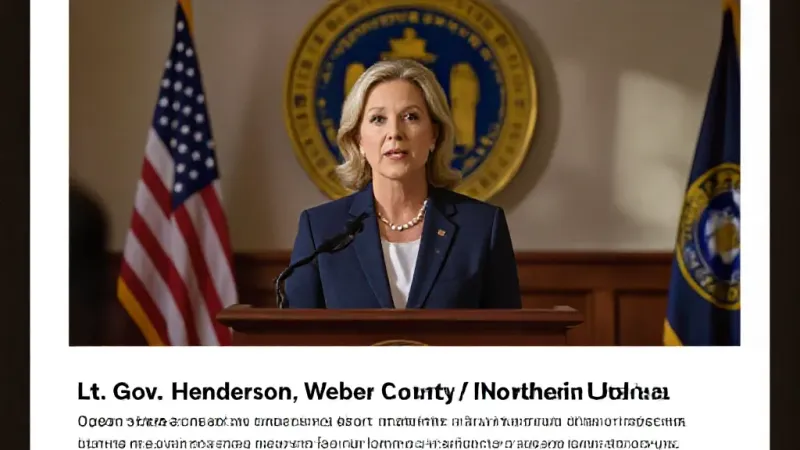
Utah Lt. Gov. Deidre Henderson, the state's top election official, is vocally opposing efforts from the Trump administration and Sen. Mike Lee that she states would undermine voting rights for Utahns. This stance has drawn the attention of the U.S. Department of Justice (DOJ), which is now investigating her office.
Henderson confirmed she has been under investigation by the DOJ since 2025, a development she learned of last month, following her refusal to release private voter data. The DOJ had threatened criminal prosecution. While Henderson maintains her refusal is lawful, noting that 23 courts have agreed with her position, she stated she would comply if a court order mandated it. She also explained that her office offered the public version of Utah’s voter rolls to the DOJ, but they did not accept this offer.
The Lieutenant Governor has also criticized a proposed executive order from the Trump administration aimed at changing how the U.S. Postal Service (USPS) processes mail-in ballots. This rule would have required states to send voter information to the federal government and would have prohibited the USPS from delivering or collecting mail-in ballots from individuals not confirmed as eligible voters. Henderson called the potential rule an “unmitigated disaster” if it were to take effect close to this year's election. While the rule is currently tied up in the courts, Utah clerks do not anticipate it will impact elections this year.
Henderson joined a legal brief with election officials from both red and blue states, urging the courts to preserve existing mail-in ballot processes for the upcoming election. She emphasized that election officials, unlike politicians, must contend with the practical realities of implementing changes, pointing out that such a late rule would require reprinting ballots and would affect overseas and military ballots already in transit.
Separately, Henderson has publicly challenged Sen. Mike Lee’s proposed SAVE Act. She has stated that this legislation would “hurt Utah voters and preempt state laws in ways that don’t make sense” and would be “impossible to implement.” In an interview conducted as part of the We Vote Utah partnership between KUER, PBS Utah, and Utah News Dispatch, Henderson suggested that the effort to implement the SAVE Act immediately, without providing sufficient time for adaptation, aims “just to disenfranchise people,” a goal she described as “despicable.” She further noted that Sen. Lee did not consult her before advancing the act and that she primarily learns about his actions when “he tweets about me.”
Despite sharing her Republican party affiliation with Lee and former President Trump, Henderson has remained a staunch advocate for Utah's established voting system. She told KUER, PBS Utah, and Utah News Dispatch that what she perceives as “gamesmanship” with voting rights for political gain “keeps her up at night.” She underscored the importance of protecting Utahns’ voting rights, describing them as “sacred” and not something to be “mucked around with for political purposes.” Henderson expressed concern over “the chaos and confusion that’s being created, the guardrails that are being destroyed,” stating these outcomes are not worth any motivation. She views her role as protecting voters from powerful outside forces that she says are trying to disrupt Utah’s election system. Despite the pressures, she stated she feels “fine” and is “just doing my job.”
Utah has a long history of mail-in voting, consistently lauded by state leaders across the political spectrum as a safe and secure method. The Republican-controlled Utah Legislature began allowing counties to conduct elections entirely by mail nearly 15 years ago. Since 2018, most of Utah's counties have primarily utilized mail-in voting while continuing to offer in-person options. Since 2020, it has been the state's default method, with ballots automatically sent to all registered voters. Research by the conservative think tank Sutherland Institute indicates that as mail-in voting has grown in popularity, voter turnout has also increased. Henderson has consistently defended Utah's system as highly secure and accessible, while also supporting efforts to improve wherever possible. Although Utah lawmakers have recently moved to slightly reduce universal mail-in voting, introducing more ID requirements and requiring voters to opt-in for mail ballots by 2029, Henderson continues to advocate for its core principles. She cautioned that if mail-in voting were significantly restricted nationally, Utah's election system, largely built around this method since 2018, would face considerable disruption.