
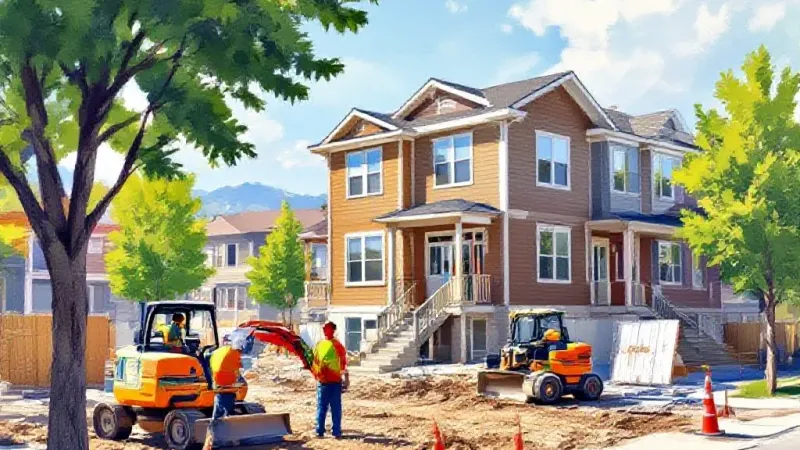
A 193-unit affordable housing development, Lotus Forge, is moving forward in Ogden, backed by a $17 million private-activity bond from the Utah Housing Corporation. The project, developed by The Lotus Co., is designed to be 100% affordable, aiming to address the critical need for income-restricted housing in the community. It could ultimately cost as much as $65.4 million, according to figures discussed at an August Utah Housing Corporation meeting.
Lotus Forge is situated on 3.5 acres near prominent Ogden landmarks. Multi-Housing News places the project at 2270 Lincoln Ave., across the street from Lindquist Field stadium. However, Utah Housing Corporation’s own filings list the project at 2261 Grant Ave., according to its Private Activity Bond Program notice. An Ogden City agenda item separately references a “Forge mixed-use building” extending into the Lincoln Avenue right-of-way at 2270 Lincoln Avenue, which does not fully clarify the residential project’s precise address. The Ogden train station is within walking distance of the site.
The $17 million bond from Utah Housing Corporation was obtained by The Lotus Co., as reported by Multi-Housing News citing Yardi Matrix data. U.S. Bank is serving as trustee, and the bonds were placed with Citibank. Citibank, N.A. will also serve as both construction and permanent lender, according to a Utah Housing Corporation meeting document. Separate Utah Housing Corporation meeting records show these bonds are expected to mature on or before August 1, 2063, with an interest rate not to exceed 12% per annum.
Further financial backing includes Raymond James serving as the state of Utah’s housing credits equity provider for the deal, as per the same Multi-Housing News account. The developer requested $2.7 million in federal 4 percent low-income housing tax credits, a motion that meeting participants supported during August meetings, according to meeting documents. Utah Housing Corporation’s public meeting notices independently confirm the $17 million allocation for a 193-unit, 100% affordable new-construction project by the Lotus Company, noting it received a second extension in July, a detail from a Utah Housing Corporation meeting document.
Upon completion, Lotus Forge is expected to offer one- to three-bedroom apartments. These units will be set aside for residents earning 60 percent or less of the area median income, the Multi-Housing News report states. Planned amenities for the complex include a swimming pool, a spa, deck space, two clubhouses, a gym, and a dog park.
This is not The Lotus Co.’s first affordable housing venture in Ogden. The developer broke ground in 2025 on the 97-unit affordable Lotus Ember project on the same block as Lotus Forge. That project began leasing earlier this fall, according to Multi-Housing News. The Lotus Co. has developed approximately 500 units in Ogden in recent years and possesses more than 15 years of multifamily development experience across Utah, Florida, and Ohio.
The company also owns Lotus Riverwalk, another affordable complex in Ogden. Developed by The Lotus Co. and managed by Evergreene Management Group, all 110 existing units at Riverwalk have income restrictions. An additional 174 units were expected to become available in September, according to Utah Stories. At Riverwalk, individuals earning less than 60 percent of Ogden’s area median income may qualify, with rents estimated to be about half as much as comparable apartments nearby. Features at Riverwalk include large, open units, oversized closets, quartz countertops, in-unit washers and dryers, a club room, and a barbecue area, the same report detailed. Beyond Ogden, The Lotus Co. also owns The Lotus, an 84-unit community in Salt Lake City completed in 2013, Multi-Housing News notes.
The advancement of projects like Lotus Forge comes as Ogden and Weber County face significant pressure on housing affordability. Average rent in Weber County increased by 63 percent between 2018 and 2022, Utah Stories reports. Meanwhile, Ogden’s median home sales price was $360,000 at the end of 2023, which is about two-thirds of the statewide average of $539,000. The Weber Housing Authority’s Section 8 waitlist had grown to 1,356 applicants, with new applicants facing an estimated four-year wait, according to the same report. The developer’s expanding footprint in the city aims to address a market that remains tight for both renters and buyers.