
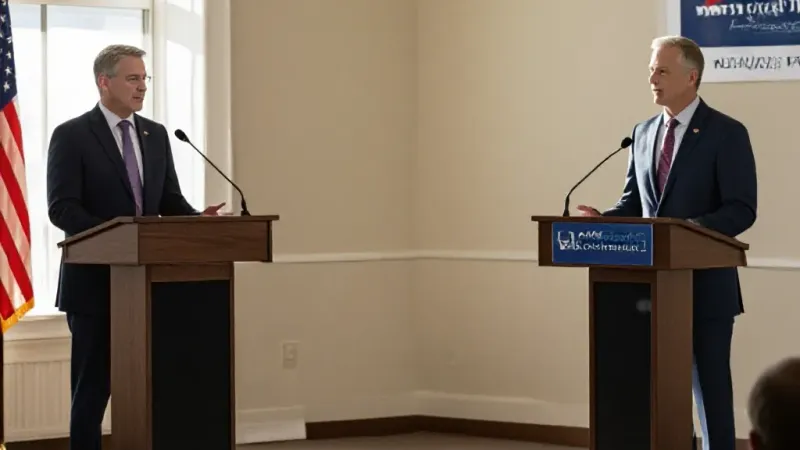
Republican Rep. Mike Kennedy and Democratic challenger Jonny Larsen debated Thursday at Snow College in rural Sanpete County, sparring over critical issues for Utah’s newly drawn 4th Congressional District. The discussion, hosted by the Utah Debate Commission, saw Kennedy defend his first term in Congress while Larsen characterized the race as a choice between approaches to the Trump administration. Key topics included actions against Iran, public lands management, and immigration enforcement.
The 4th Congressional District, largely rural and heavily Republican, encompasses the entirety of Tooele, Juab, Millard, Sanpete, and Sevier counties, alongside portions of southern Salt Lake and western Utah counties. Candidates are vying to represent this expansive area.
During the debate, Larsen condemned what he termed the “Iran War,” stating that ending this military action is essential to bring order and drive down fuel prices. He criticized Rep. Kennedy for repeatedly voting against a war powers resolution, which would require congressional approval for presidential military action. Larsen, a veteran who completed two combat tours, emphasized his understanding of the significant cost paid with American blood.
Kennedy, currently representing Utah’s 3rd House District, stated he is proud of President Donald Trump’s actions against Iran. He argued that Iran “have to be dealt with,” acknowledging potential short-term pain for long-term gain. Kennedy added that hindering the president during a national security crisis is not the correct course of action. Regarding gas prices, Kennedy said he sponsored legislation called the “License to Drill Act,” which aims to extend federal oil and gas permitting fees, to help lower costs.
On the topic of public lands, Kennedy suggested “there is an opportunity for us to use those lands in a responsible fashion.” He voiced support for allowing communities with small federally controlled tracts to utilize those parcels for developing homes. Larsen disagreed with this approach, expressing concerns about potential impacts from mining and drilling projects on groundwater in rural areas. He stressed the need to protect the water supply and public lands for indigenous people and tribes.
Immigration enforcement also saw differing views. Larsen described U.S. Immigration and Customs Enforcement (ICE) operations as “very sinister,” referencing reports of ICE officers detaining people at a turkey processing plant in Moroni, which he said resulted in separated families. He questioned how such actions align with family values. Kennedy countered that the primary focus of federal immigration enforcement should be on criminals. He stated that citizens are safer as a result of Trump’s policies at the U.S. border and expressed his dedication to making legal immigration easier.
Larsen experienced a momentary lapse during a question about energy, calling it a “brain fart,” but later returned to the topic. In his closing statements, Larsen pitched himself as a moderate Democrat focused on fiscal responsibility and national security, urging voters to work on common issues rather than fighting over disagreements. He posed the question of whether voters preferred a “blue dog” or a “lap dog” to the administration.
Kennedy used his closing remarks to speak about Utah’s pioneer history and the opportunity to build a brighter future for the state. He told reporters after the debate that he’s worked collaboratively with Democratic colleagues, stating that eight bills he sponsored have won approval from the U.S. House, and every one was a “collaborative effort.” He also conveyed that he’s “just getting started making Washington smaller and Utah stronger.”
Libertarian candidate Taylor Wright and unaffiliated candidate Steven Burt are also competing for the 4th Congressional District but did not meet the criteria to participate in the debate, based on a poll commissioned by the Utah Debate Commission.