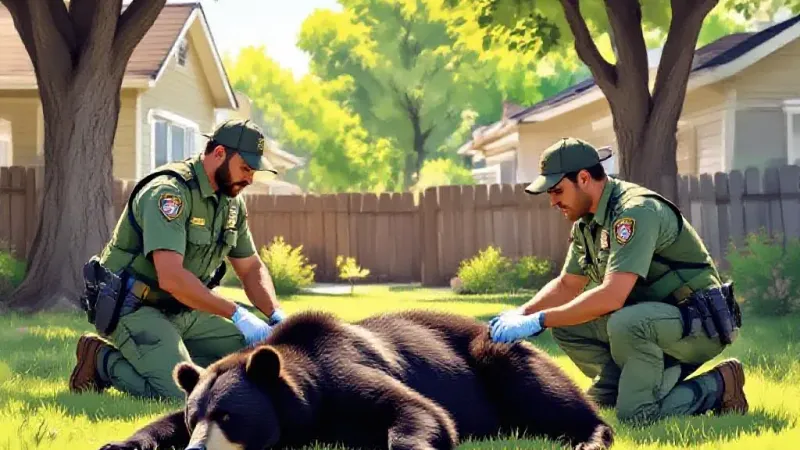
A black bear was tranquilized and safely removed from a tree in Salt Lake City's Avenues neighborhood late Wednesday evening, following reports of its presence in the foothills and residential streets. The removal, which involved officers from the Utah Division of Wildlife Resources (DWR), Salt Lake City police, and fire departments, adds to a growing number of bear sightings and encounters across Utah. This incident marks the second bear removal from a northern Utah residential area on Wednesday alone.
The DWR first received reports on Tuesday of a bear moving through the foothills area. By Wednesday, it was spotted within the Avenues neighborhood, prompting the multi-agency response. Biologists ultimately located the animal in a tree just after 9:30 p.m., where it was tranquilized before being safely taken from the area.
Avenues resident Jeff Pendleton, who captured the bear on camera, described his initial surprise. He stated his first thought "was that it was a dog or a coyote." As a lifelong Utah resident and a relatively new Avenues resident, he noted that spotting a bear cub in his backyard was unexpected. "Definitely a long way from where it came from, presumably," he added.
Earlier Wednesday, officials in Wasatch County had also safely removed a bear after it was observed near the Heber City Airport. Both incidents underscore the increasing frequency of bears venturing into populated areas.
Chad Wilson, speaking for the DWR, provided context for the rise in sightings, noting that this "has been a really hard year for bears." Wilson attributed the challenging conditions to environmental factors: a warmer-than-normal winter followed by a spring freeze. These conditions negatively impacted the natural vegetation that black bears rely on for survival.
According to Wilson, when food sources are scarce, young bears may be separated from their mothers earlier than usual or face greater difficulty finding sustenance in their typical mountain habitats. This often leads them to explore new areas, including urban and residential zones, in search of food.
Pendleton's observations of the Avenues bear appeared to align with Wilson's explanation. He described the animal as appearing "very disoriented and hungry," adding that it seemed confused while likely searching for food.
Wilson cautioned that residents should expect to see more bears in unusual locations. He predicted that the bear removed from the Avenues, along with others, will likely reappear later this year. Wilson concluded that residents should anticipate an increase in bear sightings in urban areas and locations where they are not typically found, particularly as fall approaches.