
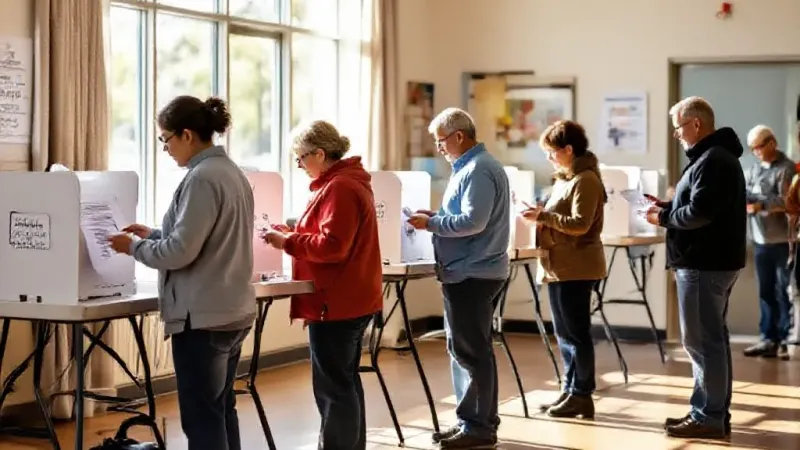
Utahns voting in this election will encounter two proposed changes to the state's foundational governing document, the Utah Constitution, presented as Amendment A and Amendment B. These amendments carry long-term implications for how state leaders inform the public about constitutional changes and how citizens can enact certain laws at the ballot box. Voters will receive their by-mail ballots starting this week and need to understand these important questions.
Amendment A proposes to remove the explicit requirement for all future constitutional amendments to be published in newspapers before an election. Currently, the Utah Constitution mandates publication in “at least one newspaper in every county of the state, where a newspaper is published for two months” immediately before an election. If voters approve Amendment A, this would be replaced with a more flexible rule: publication “in a manner provided by statute, for 60 calendar days” immediately before the election.
This proposed change follows controversy surrounding previous constitutional amendments. Utah lawmakers put Amendment A on the ballot after two proposed constitutional amendments for the 2024 ballot were voided by the courts. This was partly due to state leaders failing to meet constitutional publication requirements and partly because misleading and inaccurate ballot language was used to describe their effects.
Should voters approve Amendment A, state law would change through HB481, which was approved during the 2025 legislative session. This would require the lieutenant governor to publish the full text of all proposed constitutional amendments and other ballot questions from the Legislature on the state’s Public Notice Website and on the lieutenant governor’s website for 60 days before the election.
Proponents argue this change would modernize Utah’s public notice practices and could reduce state costs. According to a fiscal analysis included in the state’s voter information pamphlet, approving Amendment A and enacting HB481 could save the state up to $1.4 million every two years. Rep. Anthony Loubet and Sen. Daniel McCay, both Republicans, wrote in favor of the amendment in the voter information pamphlet, stating that most Utahns now rely on digital sources rather than newspapers. They argued it would allow public notice to “adapt as technology evolves” and help “maintain transparency, improve accessibility and save taxpayer dollars.” Amendment A passed with a unanimous vote in both the Utah House and Senate, and there is no known organized effort to oppose it. No rebuttal was included in the voter pamphlet due to the unanimous legislative vote.
Amendment B is considered the more controversial of the two proposals and aims to set a higher threshold for Utahns to enact certain laws through ballot initiatives, specifically those that would increase taxes. Currently, most ballot initiatives require a simple majority, or more than 50% approval, to pass. The only existing exception is a 1998 constitutional amendment requiring two-thirds approval (66.67%) for initiatives related to the “taking of wildlife,” or hunting.
If Amendment B is approved by voters, any future ballot initiative that increases taxes would need 60% approval to pass. This would apply to initiatives that create a new tax, expand an existing tax, hike an existing tax rate, or change a property tax rate in a way that results in a smaller decrease than would occur under existing law.
The potential impact of such a change can be seen by looking back at 2018, a year with several ballot initiatives. That year, an initiative for full Medicaid expansion passed with 53.3% of the vote, and an initiative to legalize medical marijuana passed with 52.7%. Both of these initiatives created new revenue streams. According to the analysis, if Amendment B’s 60% threshold had been in place, neither of these initiatives would have passed. An initiative from A Better Boundaries to create an independent redistricting commission also passed with 50.3% but would not have been impacted by this change as it did not increase taxes.
Proponents of Amendment B, including the Utah Taxpayers Association, argue that the change would help protect taxpayer money. Sen. Lincoln Fillmore, R-South Jordan, the question's sponsor, argued during this year’s legislative session that voters should decide whether to set a higher threshold. In arguments included in the voter information pamphlet, Fillmore and House sponsor Rep. Jason Kyle, R-Huntsville, stated that with Amendment B, Utah voters will decide “how easy should it be for your neighbor to raise your taxes?”
Critics, however, have formed a political issues committee called Utahns Protecting Our Constitution, which is financing a campaign urging a “no” vote on Amendment B. This group argues that the change would be an “unnecessary and permanent rewrite of Utah’s founding document that would weaken one of the most important tools citizens have to hold government accountable.” Utahns Protecting Our Constitution contends that the Utah Constitution should only be changed when absolutely necessary and that approving Amendment B would take away voters’ power and give politicians control over the rules.
These amendments are part of a trend of the Utah Legislature seeking to change the state Constitution. Historically, the Legislature has referred 192 measures to the ballot, significantly more than the 28 citizen-initiated measures since 1895. Measures put on the ballot by the Legislature, which require a two-thirds majority vote to be placed there, have had a higher likelihood of passing, nearly 70%, compared to just 25% for citizen-led initiatives, according to an analysis by Ballotpedia.
Over the past decade, since 2016, Utah lawmakers have proposed 20 changes to the Utah Constitution. Most of these have passed, though not all. The situation in 2024, where two proposed constitutional amendments were voided by the courts, partly due to publication failures and misleading ballot language, highlights the ongoing discussions around how Utah’s foundational document is amended and communicated to the public.