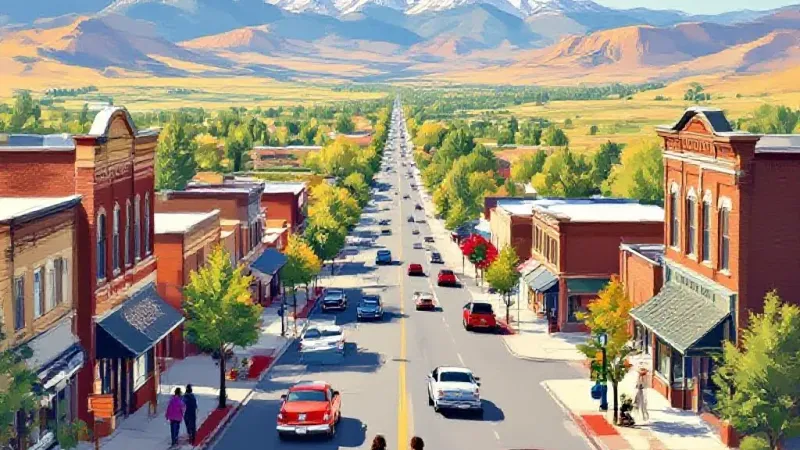
Utah's newly drawn 3rd Congressional District, which stretches across more than half the state, presents a formidable challenge for candidates aiming to represent its diverse communities in Washington, D.C. The district spans from the ski slopes of Park City in Summit County to Provo, reaching the remote Four Corners region, and includes dozens of farming communities, the boomtown of St. George, and all five of Utah’s national parks. Six candidates are currently running to lead the heavily Republican district, which also contains several Democratic communities.
Political science professor Damon Cann at Utah State University noted that whoever wins the November 3 election will need to build strong relationships across varied communities, facing "a lot of different — and at times divergent — needs to be considered." Mary Weaver Bennett, director of the Michael O. Leavitt Center for Politics and Public Service at Southern Utah University in Cedar City, described the job as requiring a "jack-of-all-trades" with knowledge of rural, suburban, and urban-adjacent issues, given the vast differences in geography, climate, and populations.
The candidates vying for the seat include incumbent Republican Rep. Celeste Maloy, currently representing Utah’s 2nd District, along with Democratic challenger Kent Udell, Libertarian Michael Stoddard, Cassie Easley of the Constitution Party, and unaffiliated candidates Adonis Hooslyn and Ayden Scott.
Voters and local government officials across the district have highlighted varied priorities and concerns about living in one of the nation’s most expansive congressional districts, which was redrawn as a result of a court order.
In Moab, City Councilmember Kaitlin Myers told KUER that the new map changes community dynamics, leading to communities "competing for resources" rather than working together. Myers emphasized that involvement from the federal delegation is crucial because Arches and Canyonlands national parks are just beyond Moab’s borders, and the majority of surrounding Grand County is federally managed public land. She explained that congressional decisions about federal lands directly impact Moab’s economy. Myers also pointed out that while the district is considered largely rural, the needs of a community like Moab differ significantly from those in Montezuma Creek in San Juan County or Cedar City in Iron County. She believes lumping these diverse areas together "dilutes the ability for a legislator to be able to actually represent the challenges of that district."
Approximately 200 miles west of Moab, Piute County Commissioner Will Talbot, a sheep farmer and Republican, shared similar sentiments. Interviewed by KUER, Talbot suggested it would be better if the district was "chopped up" to allow for more representatives. He observed that "Southern Utah has a different theory on life than people in Park City do." Talbot's primary concerns include public lands policies he views as overreach, the devastation caused by the 2025 Monroe Fire on ranchland, and economic struggles faced by residents in his county, including rising gas prices that offset high lamb prices. He noted that funding through the U.S. Department of Agriculture’s National Resources Conservation Service previously helped farmers with water and fencing projects but seems to have ceased in the past two years.
Hundreds of miles north in Heber Valley, dairy farmer Russ Kohler echoed the importance of USDA funding, stating it has been critical for his farm’s operation, especially as many other dairies in the valley have sold out for real estate development. Kohler noted that only two dairies remain in the Heber Valley today, down from over 130 a generation ago. He highlighted that his concerns, such as the cost of hay and milk pricing, differ from those of Southern Utah ranchers, who focus on public lands grazing and wildfire fallout. Kohler concluded that "even within the same demographic within that congressional district, we might have different needs," anticipating a "big challenge" for the elected representative to meet everyone's needs.
The job will also entail planning for the 2034 Winter Olympics, with events scheduled to take place in Summit County. Weaver Bennett at Southern Utah University stated this should be an "extra responsibility" that does not detract from rural and land issues.
Despite the competition for resources, Weaver Bennett foresees unifying forces across the diverse communities, such as persistent drought and water scarcity, as well as opposition to new data centers. She also believes tourism issues could gain "extra firepower" with Park City's winter sports and Utah’s "Mighty 5" national parks now under the same congressional boundary. However, Professor Cann believes that with only one representative for such vast public lands and national park communities, representation on these issues could be diluted, as other districts do not share the same scope of interest and investment.
The logistical demands for the elected representative will be substantial. Professor Cann explained that there is a fixed budget for House field offices and constituent services, yet the district covers three corners of the state and 18 of its 29 counties, extending to the borders of Arizona, Colorado, Wyoming, and Nevada. He concluded, "There’s just a lot of geography to cover."