
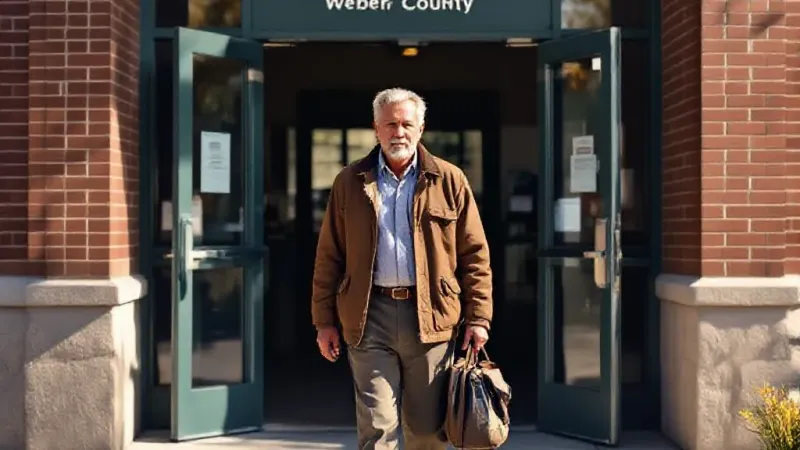
Douglas Stewart Carter, 71, was released on bail from Utah County Jail on Monday, stepping out after 40 years in state custody for the 1985 murder of a Provo grandmother. Carter, who had been sentenced to death twice, still faces a charge of aggravated murder, with a retrial scheduled for July. Prosecutors last week withdrew their intent to seek the death penalty in light of new DNA analysis from the crime scene that did not match Carter.
On Monday, Carter emerged from the jail without shackles or guards, smiling as he pushed a cart loaded with belongings, including legal documents detailing his four-decade effort to prove his innocence. Defense attorney Neal Hamilton emphasized that while Carter is physically free, he is not truly free, given the ongoing legal proceedings. Carter shielded his face and did not speak to reporters before leaving with family, but he laughed and thanked his attorneys. His son, Tyler Anger, expressed eagerness to bring his father home.
Hamilton described Carter's new reality as a challenge, noting his client lacks a phone, income, and familiarity with modern technology after 40 years behind bars. Hamilton stated that Carter is traumatized by his time on death row and will face life "minute-by-minute." He also revealed that Carter, who was held in the Utah County Jail for over a year awaiting a new trial, had not allowed himself to believe release was possible, even with an ankle monitor and strict orders not to contact Olesen's family.
Carter, originally from Chicago, was found guilty by a jury and sentenced to death for the murder of Eva Olesen, the aunt of a former Provo police chief. She was found stabbed and shot in her home in what police called a home invasion. Jurors in the original case relied on Carter's confession and evidence that he bragged to friends Epifanio and Lucia Tovar about killing a woman. After an appeal, another jury upheld the death penalty in 1992.
Almost two decades later, the Tovars, who were key witnesses, reversed their statements, alleging police had threatened them with deportation, given them gifts, and instructed them to lie about receiving financial help. Based on sworn statements from the couple, Carter appealed again. Last year, the Utah Supreme Court ordered a new trial for Carter, citing "intentional misconduct" by investigators and prosecutors. The court's opinion specifically noted that Epifanio Tovar was instructed "to fabricate a statement" suggesting Carter intended to commit rape on the night of the murder.
Prosecutors last week withdrew their intent to seek the death penalty, specifically mentioning recently tested crime scene evidence, including blood on a doorknob and DNA on a knife handle, which excluded Carter. However, Utah County Attorney Jeff Gray, in a court filing, noted that this new information does not necessarily exonerate Carter. Gray pointed out that the gun used in the crime was never found and that Carter had confessed. Hamilton countered this on Monday, stating that Carter "signed a confession under duress, which is the very definition of a coerced confession."
Carter's attorneys are pushing for the state to dismiss his case entirely. They argue that crucial evidence pointing away from Carter as a suspect, including an interrogation recording, fingerprints, plaster casts of a shoeprint, and a behavioral analysis report from the FBI, has gone missing, thus preventing him from receiving a fair trial.
Eva Olesen's family opposed Carter's bail in court on Monday morning. Theresa Olesen, Eva Olesen’s daughter-in-law, stated that the DNA report is not definitive proof of Carter's innocence and emphasized that prosecutors are still examining evidence. She also expressed distress over online videos posted by a member of Carter's family, describing them as hostile and potentially defamatory, and raised concerns about the stability of Carter's relatives' home as an environment for his release.
In his written ruling, 4th District Judge Derek Pullan acknowledged the Olesen family's disrupted sense of justice. However, he concluded that Carter does not pose a danger to them, noting that Carter had not expressed a desire for revenge to his family and had not incurred major disciplinary issues during his incarceration. Prosecutors did not oppose Carter’s release, provided he wear an ankle monitor and adhere to other conditions, pending a Nov. 10 hearing.
These recent developments in Carter's case occur shortly after Utah modified its death penalty law earlier this year, aiming to expedite the process. Supporters of the new law, including the Utah Attorney General's Office, cited instances of men on death row dying of natural causes before their executions. The new framework, sponsored by Rep. Candice Pierucci, R-Herriman, is estimated to reduce the timeline from approximately 34 years to about 20 years, while still upholding defendants' rights. However, Hamilton highlighted that in Carter’s case, state misconduct remained concealed for more than 20 years. Hamilton remarked on the expedited process, saying "this is precisely why we told them not to."