
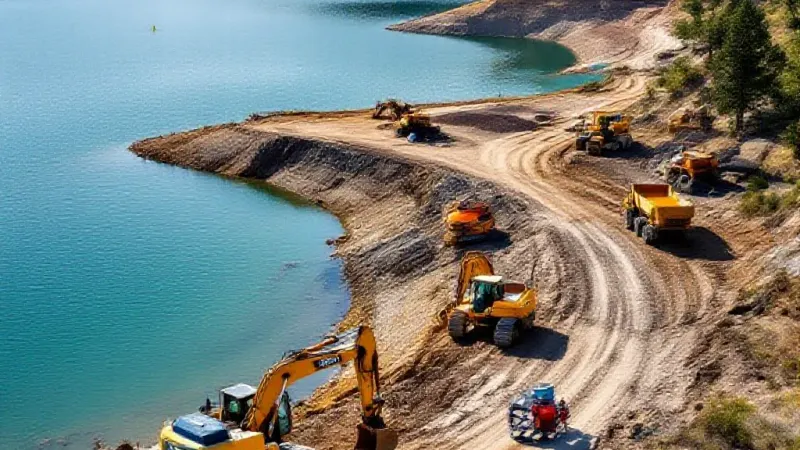
OGDEN VALLEY, Utah — Pineview Reservoir's water levels have been significantly drawn down to facilitate construction on a major infrastructure project: the replacement of a decades-old pipeline that carries drinking water to Ogden residents. Crews began work on Monday, initiating a multi-year effort that has reduced the reservoir to approximately two percent of its capacity.
The initial phase of construction involves building a platform that extends through the reservoir. This platform is necessary for moving heavy equipment required for the pipeline replacement. Following this, a temporary pipeline will be laid on the surface, while the new, permanent drinking water line will be installed underground.
Justin Anderson, Ogden City Public Services Executive Director, explained that the new pipeline will be significantly larger than the current one. He stated, “That pipeline is going to be a bigger size pipeline than the size that we currently have.” Anderson noted that this oversized design is a forward-looking measure, allowing for future expansion and building redundancies into the system. This foresight aims to prevent the need for similar reservoir drawdowns for future expansions, if required.
Community members have raised questions regarding the impact on fish populations within the reservoir. Anderson confirmed that Ogden City has collaborated with the Division of Wildlife, providing funding to install over 1,000 new habitat structures. This initiative is designed to help fish populations rebound from any potential effects of the construction work.
The timing of the project was also a strategic decision. While initially planned for next year, the project was moved up. Anderson indicated that this year's already low water levels at Pineview meant they would not have to drop levels much further. Additionally, he noted that more space was available at other reservoirs, such as Willard Bay, to accommodate water diverted from Pineview.
Officials anticipate that this specific Pineview crossing phase of the project, which is part of a larger $100 million endeavor, will be completed by January 1, 2027. This timeline is crucial to allow the reservoir to refill with spring snowmelt around that period. However, the full, comprehensive project is expected to take several more years to finish.
Jeffrey Putzke, public involvement manager with Sunrise Engineering, acknowledged that the final stages of the draw down happened “a little bit faster especially toward the end to get to this point.” However, Putzke emphasized that the natural draw down for the majority of the summer was consistent with expectations. He also highlighted a positive outcome, stating, “The good news is, we pushed a lot of water supply to irrigators, so that combined with all these repairs, things are coming along just as planned.” In a typical water year, the reservoir is expected to return to full capacity.