
Ogden, UT – Northrop Grumman, a major defense contractor whose operations contribute to the Northern Utah economy, has announced a record order backlog totaling nearly $110 billion. This backlog, specifically reported at $109.6 billion, is approximately 1.4 times the company’s market capitalization and represents roughly two and a half years of sales, according to company information.
Crucially for the local community, this substantial volume of outstanding orders includes a $7 billion award for the modernization and sustainment of the B-2 Spirit bomber fleet. This vital work is actively being carried out at several locations, including Hill Air Force Base in Utah, and is projected to continue through May 2029, supporting employment and economic activity in the region.
The Virginia-based defense contractor also reported strong financial performance for the third quarter (Q3) of 2026. Revenue for the quarter reached $11.12 billion, a 7% increase from $10.42 billion a year earlier. Net income also saw a modest rise, climbing to $1.12 billion from $1.10 billion in the previous year's third quarter.
Company filings indicate that Northrop Grumman secured $16.4 billion in net contract awards during Q3 2026. These new awards contributed to a significant increase in the net outstanding backlog, which grew from $91.4 billion at the end of Q3 2025 to the current $109.6 billion. Over the past year, the company received new contracts totaling $18.2 billion.
Kathy Warden, Northrop Grumman's Chair, Chief Executive, and President, noted in the earnings announcement that "our customers continue to turn to Northrop Grumman."
Among the specific Q3 contract awards, $4.6 billion was designated for classified programs. The company also secured $2 billion for the Sentinel intercontinental ballistic missile (ICBM) program and $1.4 billion for Virginia-class submarines. Further awards included $1.3 billion related to the F-35 fighter jet and $1 billion for the E-2 Hawkeye airborne early warning aircraft. These contracts underscore consistent demand across various defense sectors, including advanced fighter jets, surveillance aircraft, missiles, submarines, and space programs.
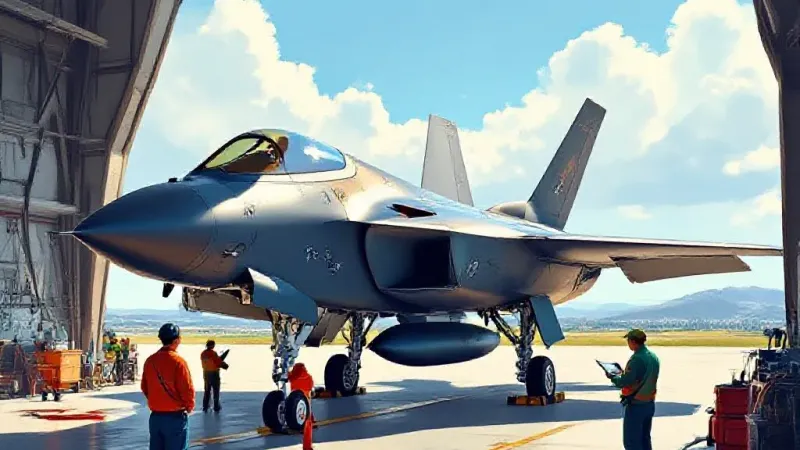
Northrop Grumman’s Aeronautics Systems sector, which directly supports operations like those at Hill AFB, reported Q3 revenue of $3.58 billion, a 14% increase year-on-year, and secured over $3 billion in new contracts. This strong performance is linked to demand for the F-35 fighter jet, progress on the B-21 Raider program, and ongoing maintenance for the B-2 Spirit bomber, in addition to work on Army helicopters such as the AH-64 Apache, CH-47 Chinook, and UH-60 Black Hawk.
As a principal contractor for the F-35 Lightning II program, Northrop Grumman contributes approximately 25% of the aircraft, producing major structural and mission systems. The company also designs and produces critical components such as the center fuselage, the AN/APG-81 AESA radar, and the Integrated Communications, Navigation, and Identification (CNI) system.
Northrop Grumman holds the prime contractor role for both the B-2 Spirit and the next-generation B-21 Raider bombers. The $7 billion award for B-2 Spirit modernization and sustainment encompasses programmed depot maintenance, engineering, software maintenance, and logistics support. This essential work, as noted, is ongoing at Hill Air Force Base in Utah, with completion anticipated by May 2029. For the B-21 Raider, the company secured the program in 2015, and earlier this year, the U.S. Air Force and Northrop Grumman agreed to expand production capacity by approximately 25% through about $4.5 billion in government funding.
The company is also the prime contractor for the LGM-35A Sentinel program, a key part of the US nuclear triad. Under this program, Northrop Grumman is designing and producing a new three-stage solid-propellant ICBM and constructing related facilities, including hundreds of new or heavily modernized hardened launch silos and associated command-and-control networks. The Sentinel program is expected to provide nuclear deterrence through 2075.
Beyond these initiatives, Northrop Grumman is a major supplier and Original Equipment Manufacturer (OEM) for key components on Virginia-class submarines. The company also plays a critical role in the Patriot missile defense system, providing solid rocket motors and ignition safety devices for PAC-3 MSE missiles. In September, Northrop Grumman secured a $4.84 billion Army contract for Common Infrared Countermeasure (CIRCM) laser-based missile defense systems to protect Army helicopters, a program set to run through 2035. Additionally, the Department of War signed framework agreements worth $3 billion for expanding Patriot interceptor missile production, with nearly $2 billion allocated for components where Northrop Grumman is a key player. The company is also involved in executing classified space-segment programs for the U.S. Air Force.
Many of these significant contracts, including those for the B-21 Raider, F-35, Sentinel, and Patriot PAC-3 MSE interceptors, are long-term agreements anticipated to span decades, ensuring a steady revenue stream for Northrop Grumman.