
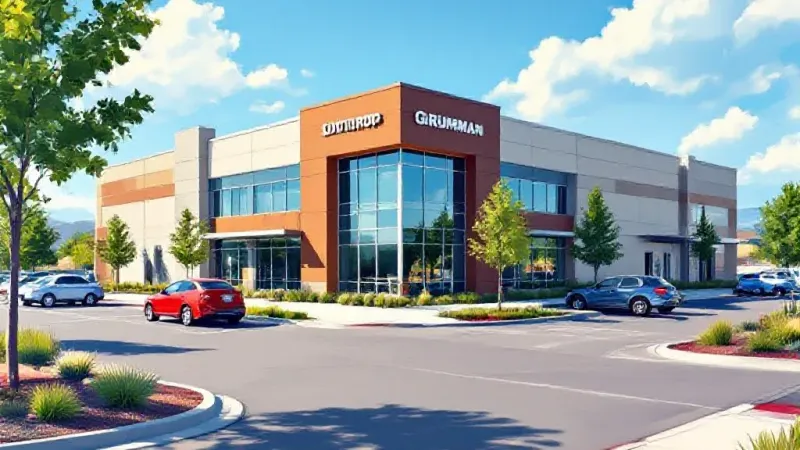
Northrop Grumman and the US Air Force broke ground on September 29 on an expansion of the B-21 Raider final assembly line at Plant 42 in Palmdale, California. This expansion is designed to increase output by one-quarter when it reaches full capacity, boosting the delivery of the B-21 Raider, a new stealth bomber.
Crucially for Northern Utah, this national production surge is also being supported by the newly opened 845,000-square-foot East Gate Three facility in Layton. Located adjacent to Hill Air Force Base, this facility is described in the source material as a "massive logistics hub tailored to sustain supply chain distribution and maintenance, repair, and overhaul (MRO) operations" for the B-21 program.
The 1-million-square-foot addition in Palmdale aims to accelerate the delivery of the B-21 Raider, as the Pentagon seeks to replace legacy bombers. The Air Force is considering increasing the total number of B-21 airframes it plans to order. Air Force Secretary Troy Meink stated that the service is moving quickly to deploy the first operational bombers at Ellsworth Air Force Base in 2027.
The 25 percent production boost at Plant 42 leverages a "digital-first ecosystem" rather than solely relying on physical space. For the first time in the defense industry, the US Air Force has direct, concurrent access to Northrop's digital twins of each B-21 being built. This approach is helping the B-21 program avoid the cost overruns and delays that have historically affected secretive Pentagon projects. Digital engineering, according to the source material, has reduced early assembly line flaws to just 1 percent, a significant improvement over the typical 15-20 percent on legacy programs.
The expansion is financed by $4.5 billion in congressionally authorized funding from the 2025 'One Big Beautiful Bill' reconciliation legislation, combined with an additional $2.5 billion private capital investment from Northrop. The Raider program has been identified as "one of the best-performing defense procurement programs in recent history." It is currently trending at an inflation-adjusted $700 million per copy, which is approximately one-third the price of its predecessor, the B-2 Spirit. The B-2 program experienced significant cost inflation due to a drastic reduction in its planned fleet size. For the B-21, the fleet scale remains stable with a guaranteed purchase of at least 100 aircraft, with a potential increase to 145 still under consideration.
Despite the program's overall success, Northrop reported a $1.56 billion loss in late 2023. This loss was attributed to inflation, which made building the first five airframes more expensive than initially projected under a fixed-price contract signed in 2015. In early 2025, Northrop intentionally incurred an additional $477 million loss for a major manufacturing process change, which CEO Kathy Warden made clear was "a deliberate pivot to enable a higher production rate."
Concurrent with manufacturing advancements, the B-21 Combined Test Force at Edwards Air Force Base completed its foundational flight testing nearly three times faster than planned, finishing in just 73 days compared to the slated 180 days, the USAF announced in May. In September, the Eighth Air Force activated the B-21 Integration Detachment One at Ellsworth Air Force Base to serve as a strategic bridge between manufacturing and real-world deployment. The Air Force Global Strike Command, which manages the strategic bomber fleet, has tasked the Eighth Air Force with ensuring initial operational capability is achieved quickly.
The USAF intends to transfer one of the test airframes directly from trials to the operational squadron at Ellsworth once beddown is complete, aiming to provide frontline aircrew with a flying example as soon as possible. By embedding operational test pilots with developmental pilots early on at Edwards Air Force Base, the Air Force expects to shave months or years off the transition timeline of preceding programs. This strategy allows the B-21 Integration Detachment One early access to draft, test, and codify standard operating procedures, training syllabi, and tactical deployment standards, using one plane to iron out any facility or power grid issues before the full squadron arrives.
The 25 percent output increase, symbolized by the Palmdale expansion, necessitates a corresponding scaling of the entire supply chain, which includes over 400 suppliers across 40 states. Tier-1 suppliers such as BAE Systems, Collins Aerospace, Spirit AeroSystems, and Pratt & Whitney are also revamping their infrastructure to match the new delivery rate, estimated by independent aviation analysts to be around 12 bombers per year. Defense Secretary Pete Hegseth and Air Force Chief of Staff Ken Wilsbach have both confirmed that a larger purchase of B-21s is currently under review.