
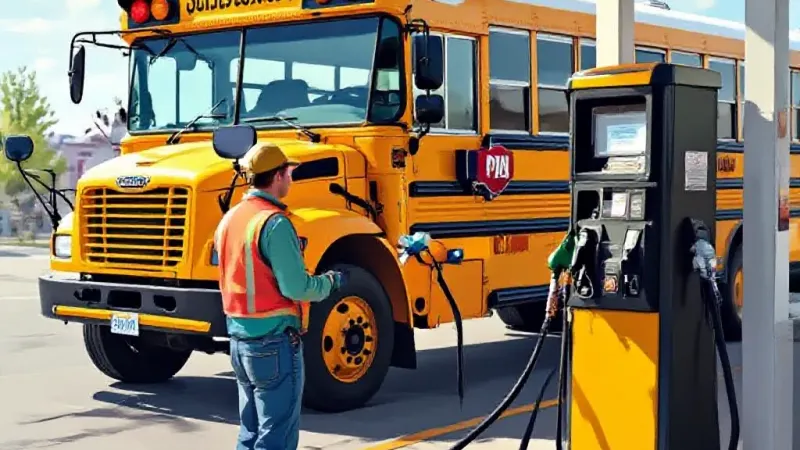
Ogden, UT – Local transportation services, including school bus operations for the Weber School District and public transit provided by the Utah Transit Authority (UTA), are grappling with the financial pressures of high diesel prices.
Lane Findlay, public information safety officer for the Weber School District, reported that the district runs approximately 153 daily routes, covering morning and afternoon student transportation, special events, Driver's Ed programs, and maintenance vehicles. Findlay noted that transportation costs constitute "a pretty big expense" for the district.
According to Findlay, the impact of escalating fuel prices became significant towards the end of the past school year, when the district was looking at almost $100,000 a month in additional expenses. Comparing last year to the current year, overall transportation costs have risen by about 30%, which translates to roughly $32,000 more per month.
Findlay highlighted a key challenge: the district's budget does not automatically increase in line with fuel costs. This unpredictability makes budgeting difficult. To manage the rising expenses, the district must move finances around, "taking money from one area and putting it toward another," which means other services or programs may experience a shortfall.
In response to these financial pressures, the Weber School District is implementing measures to save money. Drivers are now directed to refuel district vehicles at state stations rather than more expensive convenience stores. Furthermore, the district's finance office has requested that regular unleaded fuel be used for district vehicles unless a specific vehicle model requires high-octane fuel. Findlay noted that these small savings efforts are crucial, stating that "every little bit helps."
For the Utah Transit Authority, the situation is slightly different, as explained by Gavin Gustafson with UTA. The transit agency purchases fuel in large bulk batches, which means they might be utilizing fuel bought as far back as six months ago. While this bulk purchasing strategy offers a temporary buffer, Gustafson acknowledged that eventually, "the pinch is coming one way or the other" as these older, cheaper fuel reserves are depleted.
UTA's approach includes forecasting market fluctuations in advance to avoid increasing fares for riders. Gustafson confirmed that for the immediate future, looking ahead six months to a year, there are no anticipated changes or reductions in service. However, he cautioned that if current high fuel prices were to persist for six months to a year, it "would drastically change our forecasting" and could theoretically impact the services UTA is able to provide.
Both the Weber School District and the Utah Transit Authority are navigating the complexities of increased fuel expenses. The school district is actively implementing daily operational adjustments to mitigate costs, while UTA relies on its bulk purchasing strategy and long-term financial forecasting. Findlay concluded by expressing hope for "some relief in the future" from the high cost of fuel.